
10 Things I’m Thankful For Because I Grew Up Without Toxic Screens
by Evan Hempe

Intro From Melanie
As the mother of 4 now-grown children, having the whole family seated around one table for Thanksgiving is something I am more grateful for than ever. Hearing my kids excitedly sharing their stories of college and friends and work also makes me grateful for the decision my husband and I made all those years ago to remove toxic screens from our home.
“You’ll thank me later” is something we as parents often say in the midst of eye rolls, bargaining, and that unmistakable look that says, “You cannot be serious right now.” In the moment, we aren’t sure if it’s true, only that holding this boundary is in our child’s best interest.
Now that I’ve reached this phase of life, though, I can tell you: they actually do thank you later.
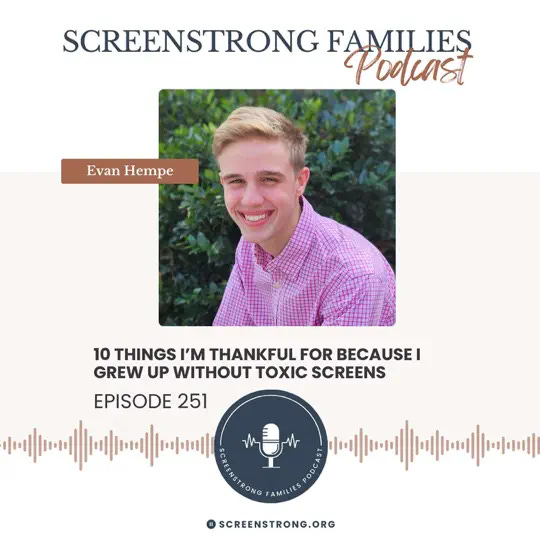
This past week on our podcast, my 21-year-old son Evan shared the 10 things he is thankful for because he grew up without the influence of social media and video games.
While I (of course) think he is an exceptional young man—grounded, confident, with a clear sense of who he is—I also know he is not the exception. He’s a glimpse of what’s possible when kids get the time and space to grow up in the real world—without constant comparison, constant noise, and constant unnatural dopamine hits from screen entertainment.
If you have young ones, let this blog give you direction. If you’re in the middle of those tricky middle school years, let this give you hope—and help you stay strong. Have your kids listen to Evan’s podcast. And if your kids are in high school, remember: it is never too late to pull the screens and shift your lifestyle. Every day counts. They will thank you one day… just like Evan.
And with that, here are Evan’s 10 things.
10 Things I’m Thankful For Because I Grew Up Without Toxic Screens
1. Real, Deep Friendships
“So there’s this kind of mantra that these tech companies want you to believe… that these screens help you connect with other people. All of that is a bald-faced lie. I have so many good friends in college. I have so many good friends when I come back home that I can see. The people you surround yourself with is pretty much what you’re going be like. So I was fortunate enough to surround myself with real people. Being able to do that definitely shaped me into a better version of myself and definitely helped me along the way.”
2. Genuine Confidence
“Without having the screen as a crutch, you have to go, and you have to look people in the eye and meet them for the first time and see how that goes, right? So not only in just like social interactions, but confidence in the things that I was doing, in the music that I was learning, in the games that I was winning and or losing, anything like that. So I think all of that just builds a ton of confidence. And confidence is, a learned skill, right? It’s not something you’re born with. It’s all learned.”
3. A Calmer, Less Anxious Mind
“ I didn’t have to live with these constant notifications or comparison. Even now, I have a smartphone. I’m in college and don’t have any social media accounts. I don’t really have that many apps. I can’t imagine these middle schoolers who have every brand of social media, plus everything else on their phones and all that. You’re just getting flooded constantly. And that’s not healthy, right? When you’re constantly being pulled in so many different directions and getting a notification every time someone likes or posts, that’s just exhausting. So, not having to focus on what everyone else is thinking, that just allowed my brain to grow, allowed my emotions to grow.”
4. Time to Develop My Skills and Passions
“In my experience, it’s not about being naturally smart or being naturally gifted at anything. It’s about immersing yourself into it, being committed to the grind, being committed to putting in work, those eight hours. I legitimately got better at baseball because of that. I got better at art. I got better at singing. I got better at piano because it takes hours. But again, that’s so countercultural because nowadays everything is so go, go, go, need it now, need it now. There’s no such thing as delayed gratification anymore.
But if you want to be good at anything, you’ve got to spend time with it, and you’ve got to just embrace it, right? I don’t have the temptation to scroll because I was built when I was younger to rely not on that, to rely on other things. And guess what? That just carries on into my life now as a 21-year-old college student. So that’s a huge one that I’m thankful for.”
5. Better Focus for School and Life
“This kind of goes back to the ‘ignorance is bliss’ thing, where not having all that social distraction around you today allowed me to focus when I needed to. It allowed me to focus on school when I was in school. Allowed me to focus on sports when I was in sports. Allowed me to focus on relationships when I needed to because I didn’t have all that extra stuff to worry about. And it’s just paid so many dividends. Having that ability to follow through will separate you, even in something as trivial as a group project in college or in a business class, as I have done. That’s a huge skill that will stay with you for the rest of your life.”
6. Good Sleep and Better Health
“Sleep is one of those things, especially in the developmental years, that if you don’t get enough of it, it’s going to show in the future. I think everyone agrees that when you get a good night of sleep, you just feel phenomenal. You just feel recharged. It’s a wonderful thing. But unfortunately, now, when you have a phone that you can scroll on, this just leads to staying up way past you need to. I think I didn’t even realize that at the time. But just knowing the importance of that, you hear all these studies on sleep and how sleep just leads to a better, healthy life.”
7. Learning to Handle Boredom
“Boredom is where creativity grows. If you have screens constantly filling up every spare minute, your brain is never going to be bored. But that’s not a good thing. Boredom has such a negative connotation, but boredom is not a bad thing in and of itself. You learn how to think, imagine. Like it’s fun to imagine things, to walk yourself through. And so allowing that space for boredom without the screens, without that constant crutch, that is huge. It’s something that I definitely have grown from, and I definitely am thankful for.”
8. No Digital Mistakes Following Me Forever
“There are so many things that I said in high school, middle school, and in elementary school. Even now, there are so many things that I’ve said that I’m ashamed of. And I can’t even imagine if they were online following me around. And so I think that’s a huge advantage that I have that I don’t have to worry about. I’m extremely thankful that’s not following me around and that I get to step into a professional world where I don’t have to worry about that.”
9. A Strong Sense of Who I Am
“When I was in middle school, me and my twin Andrew, we got mocked for not having video games, for not having social media, phones, all that. And by the time ninth or 10th grade came around, man, people respected that. Our house became the hangout spot because we would do real stuff. We would do real games. We had a good time. Andrew and I could talk about so many different things because we’d been introduced to so many different worlds as kids, sports, music, art, culture, all of that stuff.
People were, were pretty shocked by, by kind of who Andrew and I became, not having to constantly go with the flow and not having to constantly worry about what was popular, and just being confident. And people really started to appreciate that.”
10. A Close, Connected Family
“One of the things that was always just a given in our house was that we eat dinner every night as a family. My dad comes home, my mom’s there. Me, Andrew, all my siblings are there. And so that connection with that family helped me be confident in who I was, shape my worldview, and think through challenging issues. All of this stuff, having a safe place where I can come home and I can say anything, right? I can be myself. And that is so beautiful. Ultimately, I just want to create my own version of that when the time comes to find a wife, have kids, and everything like that. I just want to replicate what was going on right here.”
If you know a parent who needs hope today, please share this post with them. Evan’s perspective could be the encouragement they’re waiting for.
Final Encouragement from Melanie
If you’re reading Evan’s list and feeling a mix of hope and exhaustion, I get it.
Because the truth is, most of us aren’t doubting what’s right. We’re doubting whether we have the strength to keep doing it when the pressure is loud, and it feels like everyone else has given in.
But I want you to notice something about Evan’s words: he didn’t say, “I’m thankful my parents made me popular.” He didn’t say, “I’m thankful I never felt left out.” He said he’s thankful for the things that actually build a life—real friendships, confidence, calm, focus, purpose, sleep, identity, and family.
That’s the long game. And it works.
If you want to make changes in your family, ScreenStrong is here to help. Our Kids’ Brains & Screens Home Edition was designed to help you overcome the most challenging part of eliminating toxic screens from your home: helping your kids understand the why behind your decisions. Using the latest brain science, it will help your child understand that this isn’t about being “anti-technology” but about protecting childhood, strengthening relationships, and giving them space to become who they’re meant to be, so that one day, like Evan, they will actually say, “Thank you.”
Melanie Hempe, RN, BSN, is the founder of ScreenStrong, a nonprofit that equips families and schools with science-based education and practical tools to prevent and overcome childhood screen addiction. After her oldest son withdrew from college due to video game addiction, Melanie drew on her nursing background from Emory University to raise her three younger children free from harmful screen use.
Known for simplifying complex medical research into relatable, practical guidance, Melanie empowers parents, educators, and students through her nationally recognized Kids’ Brains & Screens series. She helps families live counterculturally by avoiding the most harmful screen use—smartphones/social media, violent video games, and pornography—throughout adolescence, reducing mental health risks and building stronger life skills. ScreenStrong has created what every family needs—education and community—to skip toxic screens through adolescence so teens can reach their full potential.
Melanie is a trusted voice in national media, recognized for offering clear and hopeful solutions to modern screen struggles. She provides resources through the ScreenStrong Connect Forum and hosts the ScreenStrong Families Podcast. Discover family resource materials, the new KBS Elementary Edition, and the Phone-Free Schools Guide.
Visit ScreenStrong.org to learn more and join the growing community that is saving childhood.
This is such a beautiful way to teach young people. Instead of focusing on the bad things to avoid, show them the good things they can have!
Evan, as a young adult, you are a powerful role model for the preteen and teens that Silicon Valley is targeting. Thank you for your strong voice.